Table of Contents
The bottom line: pairing self-driving trucks with next-generation bio-diesel could cut international freight emissions by up to 15%. It answers logistics' two biggest challenges at once — the driver shortage and decarbonization. Drawing on trial data from Japan, this article explains why these two technologies add up to that 15% cut, looking at fuel savings, national targets, infrastructure, and economics.
Why Self-Driving Bio-Diesel Adds Up to a 15% Emission Cut
The key is that two effects stack: the fuel savings from automated driving and the low-emission profile of bio-diesel. Optimized driving trims wasted fuel, while switching to a renewable fuel cuts emissions at the source. Adopted at global scale, this combination is expected to lower the carbon footprint of international shipping by 15%.
- •If adopted worldwide
- •Cuts international shipping CO2
For the real-world side, a fully bio-fueled autonomous truck has already covered a long-distance demo run in Japan — we cover it in detail in our report on Japan's first 500 km fully bio-fueled self-driving truck demo. Reading both gives the full picture.
- •Rely on fossil diesel
- •Require a human driver
- •Depend on large logistics hubs
- •Large room to cut fuel and emissions
- •Run on renewable fuel
- •Navigate expressways driverless
- •Flexible distribution points
- •Better mileage, lower emissions
How Autonomous Trucks Are Reshaping Logistics
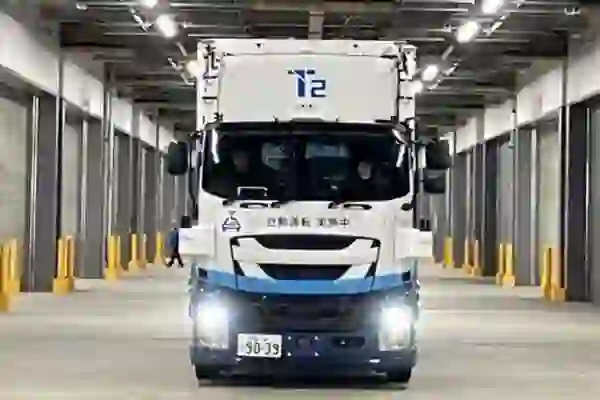
Japan's freight sector has long led on automation, and the current focus is self-driving trucks that navigate expressways without a human driver. Trials have shown they can travel safely and efficiently on high-speed roads, especially when paired with dedicated lanes and advanced sensor suites. They also reduce the need for large traditional logistics hubs, enabling flexible distribution points closer to end-customers.
The payoff goes beyond shorter transit times and easing the driver shortage. Thanks to optimized driving patterns and reduced idling, autonomous trucks demonstrated fuel savings of up to 10% compared with conventional trucks.
- •Optimized driving patterns
- •Reduced idling time
What Bio-Diesel Brings to the Table
As Japan pushes toward renewable fuels, bio-diesel is a strong candidate to power autonomous fleets. Derived from plant oils or waste fats, it runs in existing diesel engines with minimal modification. Because it keeps the power needed for long-haul work while producing cleaner exhaust, combining it with autonomous technology delivers a dual benefit: lower greenhouse-gas emissions and lower operating costs.
- •Finite, crude-oil based
- •Emits greenhouse gases when burned
- •Price tied to crude markets
- •Made from plant oils or waste fats
- •Runs in existing engines, minimal changes
- •Delivers long-haul power
- •Cleaner exhaust
This direction aligns with national policy. Japan aims to cut CO2 emissions by 26% by 2030 relative to 2013 levels, and bio-diesel can contribute significantly. The renewable-diesel effort by Idemitsu, T2, and Isuzu is covered in our article on the Idemitsu x T2 x Isuzu autonomous truck launch.
- •Target relative to 2013 levels
- •Bio-diesel can contribute
What the Trial Data Show
The trials centered on building a new logistics line that integrates autonomous trucks into the existing highway network. Engineers tested, in turn, lane discipline, response to traffic signals, and complex merging. Results showed the trucks could navigate high-speed roads safely, especially where infrastructure — dedicated lanes and intelligent signals — was optimized for automated traffic. They also highlighted that real-time data exchange between vehicles and roadside units is essential to scaling operations.
The trials gathered data on vehicle performance, driver behavior, and traffic flow, producing a rich dataset for further research.
Infrastructure and Policy Hurdles
Deploying bio-diesel-powered autonomous trucks demands coordinated work across sectors. It comes down to three fronts: expanding the fueling network, updating regulatory frameworks, and securing public-private funding. In particular, bio-diesel stations able to serve heavy trucks, plus high-speed data links and edge-computing nodes to support real-time decision making, will be essential.
Economic Impact and Global Ripple Effects
The shift to autonomous, bio-diesel-powered trucks will reshape the economics of Japan's freight sector. Operating costs should fall thanks to lower fuel use and reduced labor, but heavy investment in new technology, training, and infrastructure is required. Driver roles will shift toward fleet managers, data analysts, and maintenance technicians, creating reskilling opportunities. Upfront outlays for autonomous platforms and refueling stations may be offset by long-term savings and emissions-focused subsidies.
- •Lower fuel and labor costs
- •Reduced emissions
- •More resilient supply chain
- •New specialist roles created
- •Upfront tech, training, infrastructure
- •Regulation and standardization
- •Reskilling of former drivers
The lessons will ripple worldwide. Countries facing similar driver shortages and environmental targets can adopt the same model. Scaling hinges on three things coming together: robust bio-diesel supply chains, standardized autonomous-vehicle protocols, and supportive policy environments.
Key Takeaways
Japan's autonomous truck trials are not just a tech showcase — they signal a strategic shift toward greener, more efficient logistics. The essentials:
- 15% emission cut: global adoption could lower the carbon footprint of international shipping.
- Up to 10% better mileage: from optimized driving and reduced idling.
- 26% CO2 cut by 2030: bio-diesel contributes to the national target.
- Keys to scaling: fueling infrastructure, regulation, and public-private cooperation advancing together.