Table of Contents
Overview
- •Repairs add up fast
- •Higher insurance & tax
- •Risk of surprise breakdowns
- •Saves thousands of yen a year
- •Lighter insurance & tax
- •Lower breakdown risk
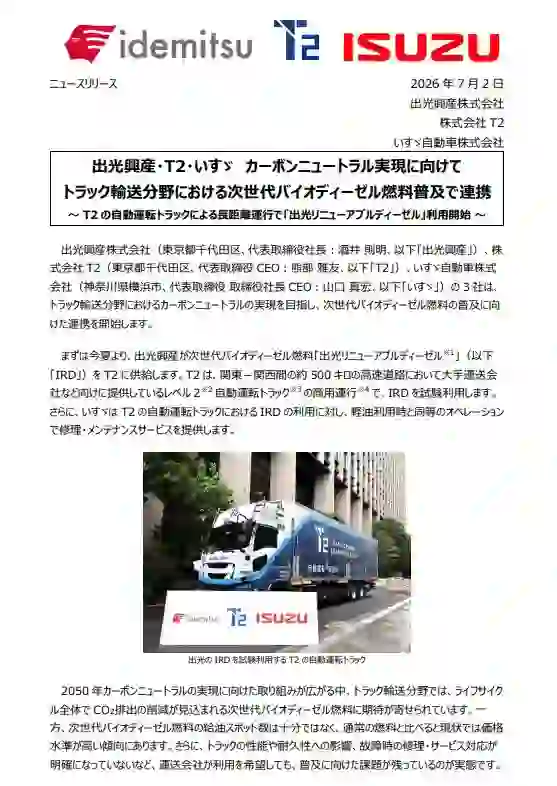
Energy major Idemitsu has teamed up with T2 and Isuzu to pilot autonomous heavy-haul trucks running on renewable diesel. The goal is straightforward: cut carbon emissions from long-distance freight without giving up the performance and reliability that logistics demands. Idemitsu supplies the low-carbon fuel, T2 provides the self-driving technology, and Isuzu contributes engine and vehicle integration. Together they aim to set a benchmark for sustainable freight in Japan and beyond.
The Vision: Low-Carbon Long-Distance Transport
Global freight is under mounting pressure to cut greenhouse-gas emissions, and Japan's Ministry of Land, Infrastructure, Transport and Tourism has set ambitious targets for 2030. Idemitsu's renewable diesel, made from plant-based feedstocks, offers a carbon-neutral alternative to conventional diesel. Paired with autonomous driving, its lower emissions are amplified further: smoother acceleration and braking reduce both fuel consumption and tailpipe pollutants. The partnership therefore targets a future where long-haul trucks operate with minimal environmental impact.
T2 Autonomous Truck: Technology and Capabilities
T2's autonomous platform combines LiDAR, radar, and high-definition cameras to navigate complex road networks without human intervention. The control system is built for heavy-load operation, holding precise lane position and adaptive cruise control even on highways. In the pilot, the truck runs on a dedicated test track that simulates real delivery routes while monitoring energy efficiency, safety incidents, and driverless-operation reliability.
Renewable Diesel: A Sustainable Fuel for Heavy Haul
Renewable diesel is produced by hydrotreatment, which converts vegetable oils or waste cooking oil into a fuel chemically identical to petroleum diesel. Existing diesel engines can burn it without modification, which greatly simplifies adoption. Idemitsu's renewable diesel carries a lower carbon intensity, with life-cycle emissions cut by up to 70% compared with fossil diesel. The pilot evaluates how the fuel behaves under the high-load conditions typical of autonomous trucks, measuring combustion efficiency, engine wear, and emissions.
The Isuzu Partnership: Integrating Systems and Infrastructure
Isuzu, a leading commercial-vehicle manufacturer, brings decades of diesel-engine and vehicle-integration experience. The collaboration embeds Isuzu's engine and drivetrain into T2's autonomous chassis, ensuring seamless communication between the control software and the powertrain. The partners will also explore charging infrastructure for hybrid or electric variants, creating a flexible fleet that can switch between renewable diesel and battery power depending on route length and payload. For wider context on the shift toward electric drivetrains, see our report on the rise of non-Japanese EV share in Europe.
Pilot Trials and Future Outlook
- •Price 1,907,000 yen
- •Insurance 50,000 yen/yr
- •Maintenance 18,000 yen/yr
- •Economy 15.5 km/L
- •Price 2,800,000 yen
- •Insurance 70,000 yen/yr
- •Maintenance 24,000 yen/yr
- •Economy 13.0 km/L
The first phase of the pilot is scheduled to begin in late 2026, with the autonomous truck running on a 200-km test corridor spanning urban, suburban, and highway segments. The data collected will inform regulators and industry stakeholders about the feasibility of scaling autonomous, low-carbon freight. If successful, Idemitsu, T2, and Isuzu plan to roll out a fleet of 50 trucks across major logistics hubs by 2030, potentially reducing Japan's freight-sector emissions by an estimated 1.5 million tonnes of CO2 annually.
Summary
By marrying autonomous driving with renewable diesel, Idemitsu, T2, and Isuzu are charting a path toward a cleaner, smarter freight network. The pilot showcases genuine technological synergy and a replicable business model, delivering measurable emissions reductions while upholding the safety and efficiency that modern supply chains require.
For more details, see the official announcement: source and the technical brief PDF: PDF.